RV Roof Work in Florida: Reseal, Recoat or Replace
There are three different jobs people call roof work, and they solve different problems. Resealing addresses the seams and fittings where water actually gets in. Recoating addresses a membrane that ha
There are three different jobs people call roof work, and they solve different problems. Resealing addresses the seams and fittings where water actually gets in. Recoating addresses a membrane that has aged across its whole surface. Replacement addresses decking that has failed. Doing the wrong one is the most common and most expensive mistake on an RV roof.
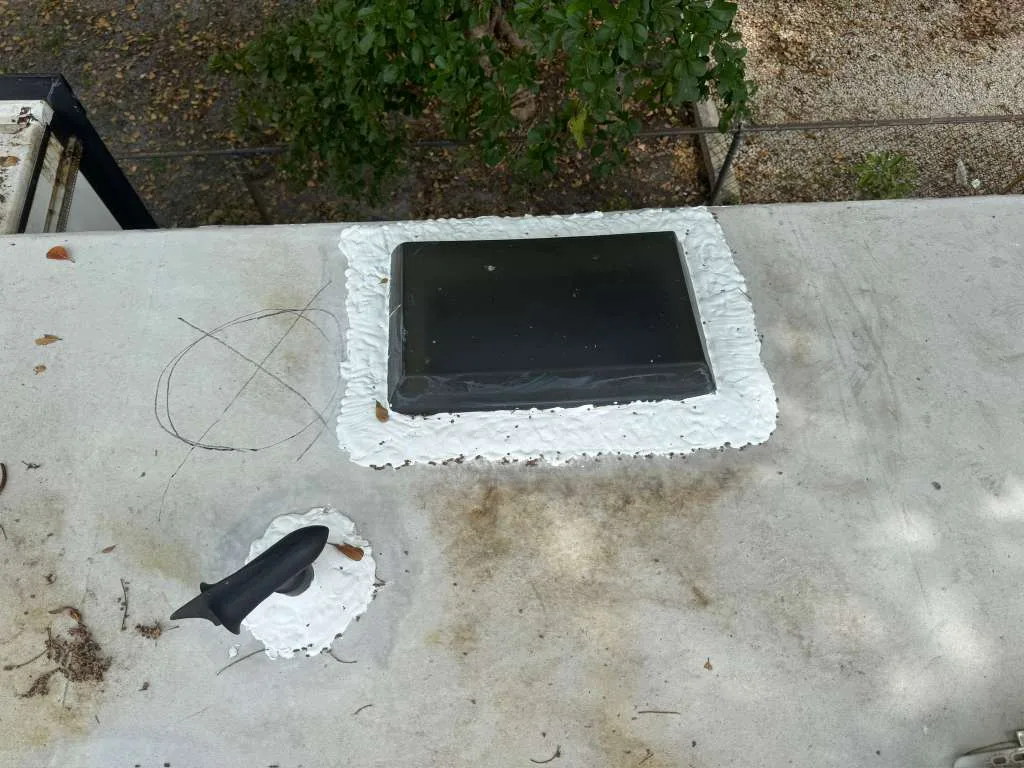
What is the difference between the three jobs?
One fixes leaks, one extends a membrane's life, and one rebuilds the structure. They are not degrees of the same work.
Resealing means cutting back failed sealant at the seams and fittings and laying fresh material on a clean surface. That is where water enters, so it is the job that stops leaks. It is also the cheapest and the one most often needed.
Recoating means applying a liquid membrane over the whole roof. It renews a surface that has chalked and aged, and it buys years on a roof that is otherwise sound. It does not fix a leak, and applied over one it seals the water in.
Replacement means stripping the membrane, replacing decking that has softened, and fitting new. It is structural work, and it is the only correct answer once the wood underneath has gone.
How do you know which one you actually need?
By looking at three things in order: the sealant, the membrane surface, and whether the roof gives underfoot.
If the sealant is crazed or lifting at the fittings and the membrane between them is sound, you need a reseal. That is the most common situation by a wide margin and it is the cheapest outcome.
If the sealant is fine but the membrane itself is chalking heavily, crazing across its area or losing surface, you are looking at a recoat - and the reseal usually happens at the same time because it is the same access.
If anywhere gives underfoot, neither of those applies. That is decking that has been wet, and a moisture survey comes before any quote so the extent is known rather than guessed. Getting that order right is what keeps this a maintenance cost rather than a structural one.
Why does a recoat over a leak cost you twice?
Because it hides the evidence while the damage carries on underneath.
A coating is a continuous film. Applied over a seam that is still letting water past, it traps that water between the coating and the decking, where it cannot evaporate and where you can no longer see the stain that would have told you.
The leak does not stop. It simply stops being visible, and it keeps working on the structure for however long it takes for the damage to reach the ceiling panel.
By then the bill is a decking replacement rather than a bead of sealant, and the coating has to come off to do it. That is why the honest sequence is always leaks first, coating second, and never the other way round. Anyone offering to coat a roof without first establishing that it is dry is selling you the second bill as well as the first.
What drives the price of each job?
For a reseal it is how much old sealant has to come off. For a recoat it is preparation. For a replacement it is how far the damage goes.
Resealing is quick where the old material lifts cleanly and slow where it has to be cut back around every fitting. A roof that has been resealed badly before - fresh sealant laid over failing sealant - takes considerably longer than one that has never been touched.
Recoating is mostly preparation. The surface has to be cleaned properly and, on some membranes, primed. Skipping that is why coatings lift, and doing it properly is most of the labor.
Replacement is priced by area of decking, and that number comes from the moisture map rather than from what is visible. Which is why a quote worth comparing says what it found, not just what it will do.
How long does each one last in this climate?
Less than the manufacturer's general figures, because ultraviolet here is relentless and the rain arrives in volume.
A reseal is a maintenance interval rather than a fix - the sealant is a consumable and it will need doing again. Inspecting twice a year and touching up what has failed keeps a roof indefinitely.
A recoat buys a genuine extension on the membrane, and how long depends almost entirely on preparation and on whether the roof is covered or shaded when parked.
A replacement resets the clock completely. It is also the point at which it is worth considering a different membrane type, since what was fitted at the factory was chosen on cost rather than for this climate. Ask what membrane is going on and why, rather than accepting whatever is cheapest to fit.
Is it worth doing on an older coach?
A reseal always. A recoat usually. A replacement only if the coach is otherwise sound and you intend to keep it.
Resealing is inexpensive relative to what it protects and it is worth doing on any coach anybody is still using. There is no age at which letting water in becomes sensible.
A recoat is a value judgement about how many more seasons you want from the coach. On something you plan to keep it pays for itself; on something heading for sale it rarely returns what it costs.
Replacement is the one that needs a conversation about the whole coach. If the roof has failed structurally, the walls beneath it are worth checking before committing, because the two are frequently connected. That conversation is worth having honestly before any money is spent, and we would rather have it than not.
What should a quote actually tell you?
Which of the three jobs it covers, what happens to the old sealant, and what was found underneath.
A quote that says roof work without naming the job is not comparable to anything. Ask specifically whether old sealant is being removed or covered, because that single answer separates a repair from a cosmetic exercise.
It should also say what product is going on which surface. Membranes are not interchangeable and neither are the sealants, and using the wrong one is a common cause of a job failing inside a season.
And it should reference the condition of the decking. Anyone quoting a recoat without having established that the structure underneath is dry is quoting on an assumption. Three questions - which job, what happens to the old sealant, and what is under the membrane - separate a real quote from a number.
What does a coach owner control?
More than they think, and all of it is cheap compared with any of the three jobs above.
Inspecting twice a year and after every storm catches failing sealant while it is still a touch-up. That single habit is the difference between a maintenance interval and a decking replacement.
Keeping the roof clean matters more here than elsewhere, because the chalky residue combines with pollen and debris into a layer that holds moisture on the surface continuously.
And shade or a breathable cover, where the coach is parked long term, slows the ultraviolet that ends every membrane. None of that is glamorous and all of it postpones the expensive conversation. Between the inspection, the cleaning and the shade, an owner controls most of what decides how often the expensive jobs come round. None of it takes more than an afternoon a year.
Sources
- Dicor - sealant installation instructions - Manufacturer specification for which product goes on which membrane and how old sealant must be removed.
- EPA - moisture and mold - Why water trapped under a coating is a structural problem rather than a cosmetic one.
- National Weather Service - Tampa Bay - Regional rainfall and storm frequency behind the maintenance intervals used here.
- Lippert Components - master manuals - Documentation for the roof structures, vents and fittings involved in each job.
Not sure which of these you are looking at? Text a photo to (866) 887-1199 and we will tell you what it is before anybody drives out.
Common Questions About This
Can I recoat a roof myself?
The application is within reach of a careful owner. The preparation is the part that decides whether it lasts, and it is also the part most people underestimate - cleaning, drying and, on some membranes, priming. A coating applied to an inadequately prepared surface lifts, and then has to come off before anything else can be done.
How do I know what membrane I have?
EPDM is rubbery and chalks white as it ages, TPO is smoother and stays whiter, and fiberglass is hard and glossy. It matters because cleaners, coatings and sealants are specific to each, and using the wrong product shortens the life of the work.
Is a leak covered by insurance?
It depends on whether the cause reads as sudden and accidental or as gradual deterioration. Storm and impact damage usually qualify; a seam that has been failing for two seasons usually does not. Dated maintenance photographs are what separates those two accounts after the fact.
Can you do roof work at a campground?
Yes, and most of it is done exactly there. What it needs is a dry roof and enough dry hours for the material to cure, which in a Florida summer means an early start rather than working around an afternoon storm.
Should I reseal before selling the coach?
A reseal is worth doing because a buyer or an inspector will look at the roof first and a failing one costs more in negotiation than the work does. A recoat rarely returns its cost at sale, though it does make the coach show better.
What happens if I do nothing?
Sealant does not stabilize - it continues to fail. The sequence from crazed sealant to a wet ceiling panel to soft decking is predictable, and each stage costs several times the one before it. Doing nothing is a decision to pay the later price.
Keep Reading
Hand-picked services, cities, and articles connected to this post.